Saher Bhamla and the Art of Making Young India Care
Saher Bhamla’s Bhamla Foundation blends climate action, culture and women’s mobility through the Pink E-Rickshaw Support Initiative.
Every generation produces people who respond to the world’s problems with alarm. Far fewer produce people who respond with architecture, who look at what is broken and begin, methodically and creatively, to build the replacement.
Saher Bhamla belongs to the second kind. In a country where climate anxiety is rising as fast as temperatures, and where young people are searching for models of engagement that feel genuine rather than performative, her work at the Bhamla Foundation has arrived at exactly the right moment.
She is, in the truest sense of the phrase, a generation’s compass. Not because she tells young India where to go, but because she shows it through her own choices, her own campaigns, and her own willingness to treat the most overwhelming problems of our era as things that can actually be solved, one initiative at a time.
Building beyond helplessness
The Bhamla Foundation’s origin story is, at its heart, a story about refusing inherited helplessness.
Climate change, gender inequality and urban environmental degradation are causes that can paralyse as easily as they can galvanise. The scale of the problem is so vast, the systems so entrenched, that the easiest response is to acknowledge the crisis and disengage from it.
Saher chose differently. She chose to build an institution that takes the enormity of these challenges not as a reason for despair but as a mandate for creativity.
What has emerged from that choice is a foundation unlike most operating in India today. The Bhamla Foundation does not fit neatly into any single category. It is an environmental organisation that thinks like a cultural institution. It is a social impact body that moves with the instincts of a media company.
It is also an NGO that has cultivated the kind of high-level partnerships, with the United Nations Environment Programme, the Ministry of Environment, Forest and Climate Change, the Brihanmumbai Municipal Corporation and the House of Lords, that most organisations spend decades trying to access.
At the centre of all of it is a young woman who understood early that the most powerful thing she could do was not choose between these identities, but hold all of them at once.
Why culture matters
Nowhere is this more visible than in the Foundation’s approach to music.
In an era when awareness campaigns are typically built around statistics and urgency, designed to inform rather than move, Saher made a different bet. She invested in original musical anthems: Bhoomi Namaskar, Dhakk Dhakk Dharti, Hawa Aane De and Tik Tik Plastic.
Each composition was crafted not simply as a message delivery mechanism, but as a genuine cultural artifact. It is something a young person might encounter on a screen and feel before they understand, something that plants a seed of environmental identity long before a campaign brief ever could.
The logic behind this is both intuitive and deeply considered. Saher understands something formal development organisations often miss: young people do not adopt causes the way they adopt arguments. They adopt them the way they adopt music, through feeling, through association and through the quiet realisation that something resonates with who they already are or who they want to become.
By wrapping climate consciousness in melody and cultural pride, the Foundation has found a way into conversations that policy papers and awareness drives simply cannot reach. Bhoomi Namaskar, an ode to the earth itself, is not a campaign slogan. It is an invitation to see one’s relationship with the planet as something sacred, something worth protecting not out of obligation but out of love.
This is Saher’s most underappreciated contribution to India’s environmental movement: the recognition that culture is not merely a vehicle for change, but its very foundation.
Pink e-rickshaws, green mobility and women’s agency
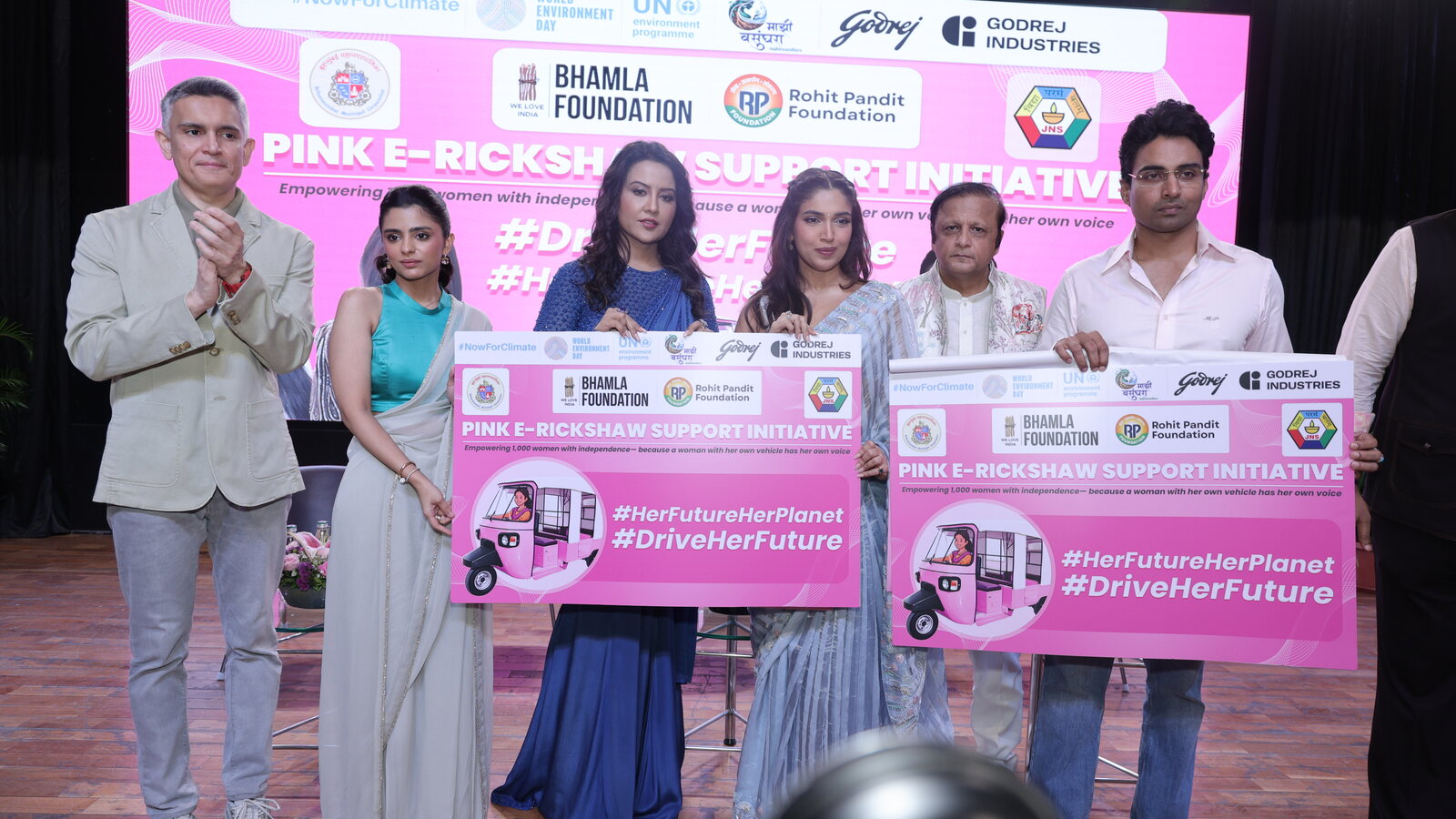
The Pink E-Rickshaw Support Initiative, launched on World Environment Day at Jamnabai Narsee School on June 1, is the most recent and perhaps most complete expression of the philosophy she has been building toward all along.
The initiative, anchored by the campaign hashtag #DriveHerFuture and aimed at empowering 1,000 women across Mumbai with their own electric rickshaws, brings together every thread of Saher’s work into a single, elegantly designed programme.

There is the environmental dimension: a thousand zero-emission vehicles replacing a thousand polluting ones on Mumbai’s roads, each journey a small but real contribution to a city fighting for cleaner air.
There is the social dimension: women gaining not just income but ownership, not just work but agency, in a public economy that has historically treated their presence as incidental.
And there is the cultural dimension: actor Bhumi Pednekar and Smt. Amruta Fadnavis, singer, social activist and banker, lending their voices and visibility to a cause that connects high-profile advocacy with grassroots reality, making the aspiration feel attainable and the achievement feel celebrated.
World Environment Day as a canvas
That Saher chose World Environment Day as the launch moment was deliberate. For her, the day is not a calendar obligation but a canvas, an annual opportunity to demonstrate that the Bhamla Foundation’s understanding of environment extends beyond trees and oceans to encompass the human environment: the conditions in which people live, work and move through the world.
Over 550 beach and mangrove clean-ups. More than 50,000 trees planted. A patron network exceeding 30,000 people. Partnerships spanning continents and institutions.
And now, 1,000 pink electric rickshaws set to roll through Mumbai, each one driven by a woman who was told, in one way or another, that this road was not hers.

These numbers tell one story. But the deeper story, the one that matters most for the generation watching Saher Bhamla work, is what they collectively represent.
They represent proof that a young person who cares enough, thinks clearly enough and builds patiently enough can move things that seemed immovable. That institutions respond to sustained, credible effort. That culture shifts when someone decides it should.
Most importantly, they show that the gap between the world as it is and the world as it ought to be is not unbridgeable. It is merely unbuilt.
Saher Bhamla is in the business of building it. With every campaign, every anthem and every pink rickshaw that finds its driver, she is handing young India the tools to build it too.